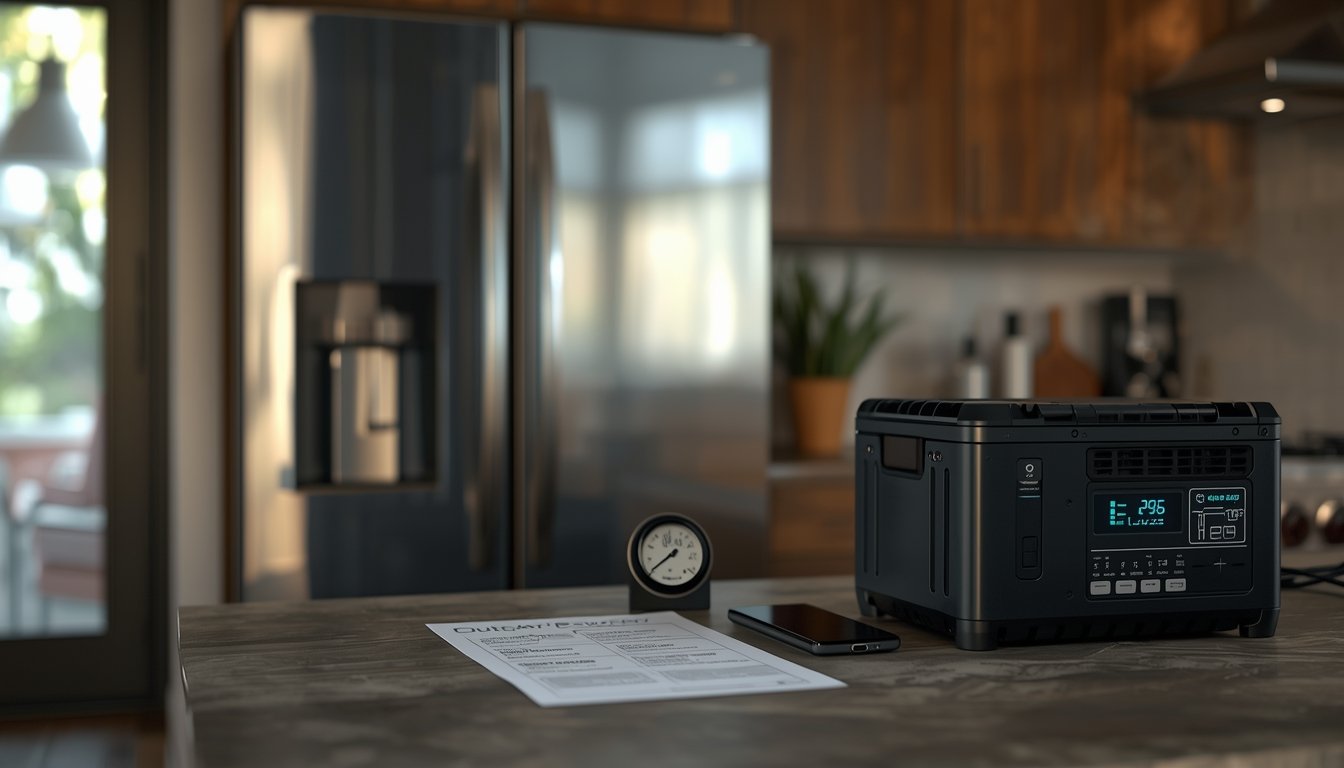
For most standard refrigerators, a backup battery should usually start around the 1,000Wh to 2,000Wh range if you want practical short-outage protection. A larger battery may be needed if you are also running a freezer, opening the doors often, or preparing for outages that last overnight or longer.
The safest way to size backup power is to look at both running watts and startup surge. A refrigerator may only use modest power while running, but the compressor can briefly need more power when it starts.
Start With the Refrigerator’s Real Power Demand
A refrigerator does not use the same amount of power every minute. It cycles on and off, which means the compressor runs for part of the hour and then rests once the cabinet reaches temperature.
This is why sizing by running watts alone can be misleading. A fridge that looks easy to power on paper may still need a battery system with enough output to handle compressor startup.
For many homes, a portable power station in the 1,000Wh to 2,000Wh class is a practical starting point for refrigerator backup. Smaller batteries may work for very short outages, but they leave less margin for startup demand, warm weather, older appliances, or extra devices.
If you are choosing a product rather than just calculating size, start with the appliance you care about most. Our guide to the best battery backup for refrigerator and freezer compares options that make sense for food-storage backup.
What Changes When You Add a Freezer?
Adding a freezer changes the sizing question because you now have two appliances cycling on and off. A refrigerator and freezer may not both start at the same moment, but your backup system still needs enough capacity and output to handle both safely.
A chest freezer can sometimes hold temperature well if it stays closed, but it still needs power during a longer outage. An upright freezer may lose cold air faster when opened, which can increase how often it needs to cycle.
If you are backing up both a refrigerator and a freezer, a larger portable power station is usually the safer choice. A 1,000Wh unit may be enough for shorter protection depending on the appliances, but a 2,000Wh or larger battery gives more practical headroom.
The more appliances you connect, the more important it becomes to avoid guessing. Check the appliance labels, estimate likely runtime, and leave margin rather than sizing the battery down to the absolute minimum.
Quick Sizing Checkpoints
- Use 1,000Wh as a practical starting point for short refrigerator-only outages.
- Consider 2,000Wh or more if you want to run a refrigerator and freezer together.
- Choose higher output if the refrigerator has a noticeable compressor startup surge.
- Add extra capacity if the appliance is older, located in a hot room, or opened often.
- Size up if you also need lights, internet equipment, phone charging, or medical devices.
How Long the Battery Needs to Last
Outage length is the biggest reason one home may need a much larger battery than another. A short evening outage is very different from a storm outage that lasts all night or into the next day.
For short outages, the goal may simply be to keep food cold until grid power returns. In that case, a moderate portable power station may be enough if the refrigerator is kept closed and no extra devices are connected.
For longer outages, capacity becomes more important. You may also need a recharge plan, especially if you are relying on the same battery for a freezer, router, lights, or medical equipment.
Solar charging can help in some situations, but it depends on sunlight, panel size, weather, shade, and how much power you are using while charging. A battery is easier to size when you know whether it only needs to bridge a short outage or support a longer emergency plan.
When to Choose a Larger Battery
- You need to run both a refrigerator and a freezer.
- You live in an area with frequent overnight or multi-day outages.
- You want to power other essentials from the same battery.
- Your refrigerator is older or has uncertain startup demand.
- You do not have a reliable way to recharge during an outage.
Final Sizing Recommendation
For a single refrigerator, a 1,000Wh to 2,000Wh portable power station is the most practical range to start comparing. It gives more useful margin than a small battery while still being easier to manage than a very large home battery system.
For a refrigerator and freezer together, move closer to 2,000Wh or above. If you also want to power lights, a router, phones, or a medical device, a higher-capacity system becomes more reasonable.
The main mistake is buying purely by advertised capacity without thinking about startup surge, appliance cycling, and outage length. A refrigerator backup system should have enough output to start the appliance and enough stored energy to keep it cycling through the outage you are actually planning for.
If you are unsure, choose more capacity rather than less. Food loss, spoiled medication, and repeated battery drain can cost more than buying a slightly larger backup system from the start.